
The Vestibular
Conflict: Why Cats Struggle with Car Travel
🔑 Key Takeaway: Senses in
Contradiction
Feline car anxiety is often caused by a sensory mismatch: the
vestibular system in the inner ear detects motion, but the eyes, focused inside a
stationary carrier, report no movement. This “sensory conflict” triggers nausea and
panic. To travel successfully, you must stabilize the cat’s environment and, if
necessary, pharmacologically adjust their threshold for stress.
For many cats, the car is a “trauma box” that only appears during annual vet
visits. However, whether you are moving across the city or embarking on a multi-day road
trip, the car environment can be managed to ensure safety and comfort. This guide provides a
strategic framework for feline transportation, from the physics of carrier placement to the
chemistry of sedation.
1. The Physics of
Safety: Carrier Placement and Forces
Internal car safety for cats is about mitigating G-forces and visual stimulus. A
loose cat is a “critical hazard” that can obstruct pedal movement or cause a collision.
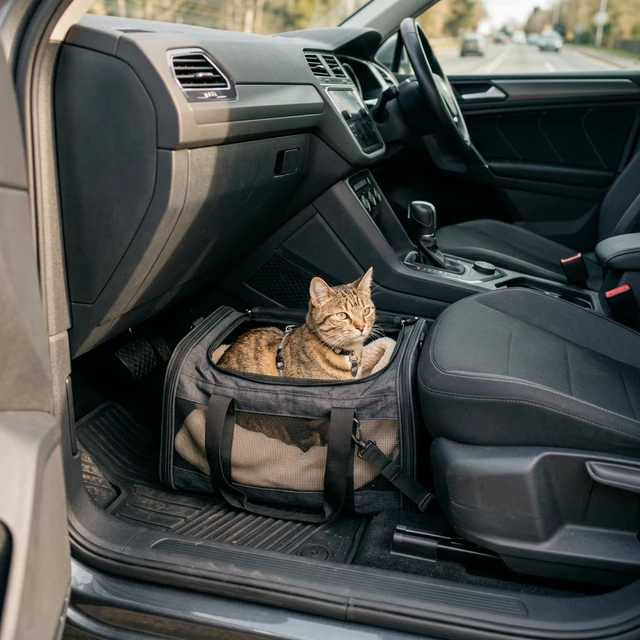
- The Stability Zone: The floorboard behind the front passenger seat is
the most stable area of a vehicle. It has the lowest center of gravity and the least
amount of “sway” during turns. If the carrier must go on a seat, it
must be secured with a seatbelt passed through the carrier’s dedicated
safety loops. - Visual Denning: Covering the carrier with a thick, dark towel is not
just to reduce light—it stops the “visual cliff” effect. Fast-moving objects outside the
window can trigger extreme vertigo in a cat’s high-speed motion-sensing eyes. - Airflow Considerations: Ensure the carrier’s ventilation holes are not
blocked by seat cushions or towels. Overheating is a primary trigger for feline car-ride
panic.
2. Pharmacological
Support: From Pheromones to Prescriptions
When behavioral desensitization fails, modern feline medicine provides several
safe options to dampen the fear response.
| Level | Option | Primary Use |
|---|---|---|
| Level 1 | Feliway (Pheromones) | Reduces mild baseline stress; builds a “safe scent” zone. |
| Level 2 | Cerenia (Maropitant) | Specifically blocks the “vomit center” in the brain; cures motion sickness. |
| Level 3 | Gabapentin | A profound anxiolytic that causes mild sedation and reduces noise sensitivity. |
3. Long-Distance
Logistics: Hydration and Hygiene
On road trips exceeding 4 hours, you must account for the cat’s metabolic needs.
Cats should not be allowed out of the carrier while the car is in motion or when
doors/windows are open.
The “Stop-and-Safety” Protocol:
Every 3-4 hours, stop the vehicle in a quiet area. With all doors and windows
securely closed, allow the cat out of the carrier for 15 minutes. Offer
water (ideally from home to ensure familiarity) and a small amount of wet food. Provide a
portable, high-walled litter box on the floorboard.
Temperature Vigilance
In summer, a car’s internal temperature can rise 20 degrees in 10 minutes. If
you must stop to use a restroom, use the “Buddy System” or leave the car running with the AC
on and a spare set of keys. If neither is possible, the cat must not stay in the car.
4. Managing the
“Vibe”: Acoustic Therapy
Cats hear higher frequencies than humans (up to 64,000 Hz). The “white noise” of
tires and wind can be abrasive to them. Research suggests that music with a tempo similar to
a feline’s purr (around 1,200 beats per minute in the high-frequency range) can
significantly lower heart rates. Avoid loud bass-heavy music, which can feel like seismic
vibrations to a cat’s sensitive paw pads.

A covered, secured carrier on the
floorboard is the safest travel configuration.
5. Post-Travel
Decompression
The trip doesn’t end when the engine stops. Reaching a new destination is as
stressful as the ride itself. Place the carrier in a small, “Safe Room” (like a bathroom or
laundry room) with familiar scents. Open the carrier door but do not pull the cat out. Let
them emerge on their own timeline, typically over the course of 2-6 hours.
Conclusion: The Gift
of Safe Transport
Mastering car travel is a fundamental skill for the modern cat owner. By
combining physical security (the carrier), sensory management (covers and music), and
pharmacological support (Cerenia/Gabapentin), you ensure that your cat can move through the
world without trauma. This flexibility is key to their long-term health and your peace of
mind.
— Last update —