
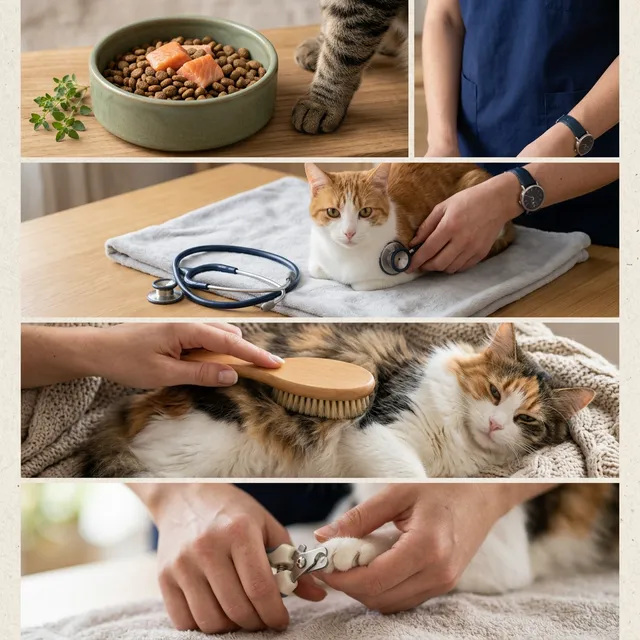
The Feline Masterclass: A
Holistic Approach to Cat Care
🔑 Key Takeaway: The Five
Pillars of Feline Wellness
Effective cat care is not a series of isolated tasks; it is a holistic
integration of Nutrition, Preventative Health, Environmental Enrichment, Behavioral
Understanding, and the Human-Animal Bond. By aligning your home and routine
with a cat’s biological and psychological evolutionary needs, you shift from simple
ownership to providing a truly optimized life for your companion. Stability is the
foundation of feline happiness.
Caring for a cat is an art form that blends science with intuition. Because felines
are evolutionary masters of masking discomfort and hiding needs, a proactive, informed approach
is the only way to ensure lifelong vitality. This comprehensive guide breaks down the essential
aspects of modern cat care, from the molecular needs of their diet to the psychological
requirements of their environment.
Pillar 1: Precision
Nutrition — Beyond the Bowl
Cats are obligate carnivores, a biological status that dictates
every aspect of their metabolic health. Unlike dogs, cats cannot survive on a vegetarian diet;
they require specific nutrients only found in animal tissues.
- The Protein Threshold: Adult cats require approximately 2-3 times more
protein than dogs. This protein is used not just for muscle, but for glucose production via
gluconeogenesis, a constant process in the feline liver. - Taurine and Arachidonic Acid: These are essential fatty and amino acids
that cats cannot synthesize. Lack of Taurine leads to retinal degeneration and heart
failure. - The Moisture Gap: Desert-evolved felines have a low thirst drive. Relying
solely on dry kibble often leads to chronic sub-clinical dehydration, a leading factor in
**feline lower urinary tract disease (FLUTD)** and kidney failure. Wet food or a multi-modal
hydration strategy is essential.
Pillar 2: Preventative
Veterinary Care — The Silent Patient
Because cats are both predators and prey, they instinctively hide pain. This makes
regular veterinary screening non-negotiable. By the time a cat “looks sick,” the underlying
condition is often advanced.
| Life Stage | Primary Care Goal | Frequency |
|---|---|---|
| Kitten (0-1 yr) | Vaccination series, spay/neuter, socialization. |
Every 3-4 weeks until 16 weeks. |
| Adult (1-7 yrs) | Weight management, dental scaling, core boosters. |
Annually. |
| Senior (7-11 yrs) | Early detection of CKD, baseline bloodwork. |
Twice-yearly. |
| Geriatric (12+ yrs) | Arthritis pain management, cognitive health. |
Every 4-6 months. |
Pillar 3: The Enriched
Environment — Verticality and Safety
An indoor cat’s world is only as big as you make it. Without stimulation, cats
suffer from stress-induced behaviors like over-grooming or inappropriate urination.
Vertical Territory: The Safe View
Cats perceive their world in 3D. A home with floor space only is half a home. Cat
trees, wall-mounted shelves, and window perches are not luxuries; they are psychological
necessities that allow a cat to monitor their territory without feeling vulnerable.
The Household Hazard Audit
Many common household items are toxic to cats. A truly caring owner maintains a
strict audit of:
- Lilies (Lilium & Hemerocallis): Even the pollen is lethal, causing total
kidney failure within hours. - Essential Oils: Tea tree, peppermint, and eucalyptus can be neurotoxic to
cats when diffused or applied. - String/Tinsel: Causes “linear foreign bodies”—a catastrophic intestinal
emergency.
Pillar 4: Grooming and
Hygiene — More Than Just Fur
While cats are famously fastidious, they require human assistance to maintain peak
condition, especially as they age and their flexibility decreases.
Coat Maintenance
Regular brushing reduces “hairballs” (which are actually
symptoms of poor digestion or over-grooming) and strengthens the human-animal bond.
Check for lumps, bumps, or flea dirt during these sessions.
Nail and Dental Health
Trim claws every 2-3 weeks to prevent painful snags.
Dental brushing (with cat-safe paste) is the only effective way to prevent periodontal
disease, which can lead to heart and kidney issues.
Pillar 5: Behavioral Health
— Understanding Feline Psychology
Most “behavioral issues” are actually a breakdown in communication. Inappropriate
scratching, for example, is not “bad” behavior; it is a natural marking instinct that lacks an
appropriate outlet.
- The Scratching Rule: If they scratch the couch, you haven’t provided a
better alternative. Sisal rope posts should be placed *directly next* to the high-traffic
areas they already target. - Litter Box Logic: The box must be cleaned daily. A dirty box is a source of
immense stress. Ensure the box is large enough (1.5x the length of the cat) and placed in a
location where they cannot be “cornered” by other pets or children. - The Hunt-Catch-Kill Reward: Use interactive toys (wand toys are best) to
mimic prey. Always end the session by letting the cat “catch” the toy and immediately
feeding them a treat. This fulfills the neurological hunting loop.
Conclusion: The Long-Term
Commitment
A cat can live for 20 years or more. This longevity is a privilege that comes with
the responsibility of evolving your care as they age. By mastering these five pillars, you
transform from a owner into a steward of a complex, sentient life. The rewards—the slow blinks,
the rhythmic purrs, and the silent, steady companionship—are immeasurable.
— Last update —