
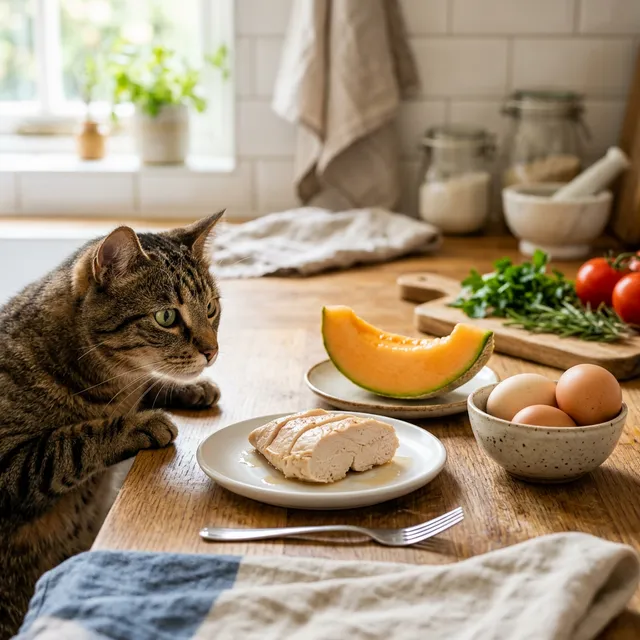
The Gourmet Minefield:
Decoding the Feline-Human Food Intersection
🔑 Key Takeaway: The 10% Gold
Standard
While sharing a morsel of food with your cat can feel like a bonding
experience, it is a high-risk gamble. A cat’s metabolism is strictly optimized for animal
protein; they are obligate carnivores whose livers lack the enzymes to
process many plant compounds that humans enjoy daily. Any human food treats must be strictly
limited to no more than 10% of their daily caloric intake to prevent
nutritional imbalances and long-term organ strain. When in doubt, leave it out.
The pleading eyes of a cat at the dinner table can be hard to resist. However, the
biological gap between a human and a feline is vast. What is a healthy snack for you—like an
onion-rich salad or a handful of grapes—can be a lethal poison for your companion. This guide
provides a definitive roadmap for navigating the “danger zone” of human foods and identifying
the few safe exceptions that can be shared in moderation.
1. Metabolic Biology: Why
Cats Aren’t Small Humans
To understand food safety, we must first understand the feline liver. Cats have
evolved with a high-protein, high-fat diet. This specialization has come at a cost: they have a
limited ability to perform glucuronidation—a metabolic process used to detoxify
many phytochemicals, drugs, and dietary additives.
- Deficiency in Liver Enzymes: Cats lack many of the enzymes (like
glucuronosyltransferase) that humans use to process plant-based toxins. This is why a tiny
amount of garlic or essential oil can linger in their system for days, causing cumulative
damage. - Glucose Sensitivity: Cats do not have the T1R2/T1R3 taste receptors for
sweetness, meaning they don’t seek out sugar—but their bodies aren’t built to process it
either. High-sugar treats can quickly lead to insulin resistance and feline diabetes. - Essential Nutrients Only: Cats must get Taurine and Vitamin A directly from
animal tissue, as they cannot synthesize them from plant precursors like beta-carotene.
2. The “Immediate Danger”
List: Strictly Forbidden
These foods are not just “unhealthy”; they are active toxins. Ingestion of even
small amounts should trigger a call to your veterinarian.
Alliums: The Red Blood Cell Killers
Onions, garlic, chives, and leeks contain **thiosulphates** and **disulphides**.
These compounds cause oxidative damage to feline red blood cells, resulting in Heinz
body anemia. The symptoms (lethargy, pale gums, dark urine) may not appear for
several days after ingestion. Garlic is approximately five times as toxic as onion.
Grapes and Raisins: The Silent Kidney
Threat
While the exact toxin is still being researched, grapes and raisins are known to
cause acute kidney failure in some cats. Even one or two raisins can be enough to start a
downward spiral in a sensitive feline.
Xylitol (Birch Sugar / E967)
Commonly found in sugar-free gum, peanut butter, and diet foods. While extremely
lethal to dogs, it is considered high-risk for cats as well, potentially causing a crash in
blood sugar and liver failure.
3. High-Risk Tables:
Contextual Dangers
The dangers in this category are often related to how the food is prepared or the
specific part consumed.
| Food Group | Specific Danger | The “Why” |
|---|---|---|
| Raw Fish/Eggs | Thiaminase & Avidin | Raw fish contains an enzyme that destroys Thiamine (B1). Raw egg whites contain avidin, which blocks Biotin (B7) absorption. |
| Cooked Bones | Internal Puncture | Cooking makes bones brittle. They can splinter in the throat or digestive tract, causing life-threatening internal bleeding. |
| Yeast Dough | Expansion & Ethanol | Raw dough expands in the stomach’s warmth, potentially causing a rupture. The fermentation process produces alcohol, leading to ethanol poisoning. |
| Liver (Excess) | Vitamin A Toxicity | Small amounts are good, but frequent large portions cause Vitamin A toxicity, leading to painful bone growth and stiff joints. |
4. The “Safe” Exceptions:
Proceed with Precision
If you simply must share, stick to these plain, boiled, or baked options in tiny
quantities (no larger than a thumbnail).
| Treat | Safe Preparation | Frequency |
|---|---|---|
| Chicken/Turkey | Boiled or baked, unseasoned, no skin, no fat. |
Occasional (2-3 times/week) |
| Plain Pumpkin | Steam-cooked or canned (100% pumpkin only). |
Good for constipation issues. |
| Scrambled Eggs | Plain, no milk, no salt, fully cooked. |
Great source of protein. |
| Melon/Banana | Tiny, seedless chunks. | Rare treat (high sugar). |
5. Holiday Safety: The
Danger of the Celebration Table
Statistically, more cats are hospitalized for food poisoning during Thanksgiving and
Christmas than at any other time of year. Watch out for these holiday staples:
- Stuffing: Almost always contains onions or garlic powder.
- Gravy: High in salt, fat, and often contains onion/garlic seasoning.
- Ham: Extremely high in sodium, which can cause salt poisoning and strain
the kidneys. - Alcoholic Eggnog: The combination of dairy (lactose) and alcohol (toxic) is
a double threat.
6. Emergency Protocol: If
Your Cat Eats Something Toxic
Time is muscle when it comes to poisoning. If you suspect ingestion:
- Identify the Substance: Check the wrapper or the ingredients list. Note the
amount consumed. - Call Your Vet Immediately: Do not wait for symptoms. For many toxins (like
lilies or onions), by the time symptoms appear, organ damage is already advanced. - Do NOT Induce Vomiting: Unless explicitly told to do so by a professional.
Some substances (like caustic cleaners or sharp objects) can cause more damage if brought
back up. - Bring a Sample: If possible, bring the packaging or a sample of the vomited
material to the clinic for analysis.
asset as a hunter, but their greatest vulnerability as a pet.”
Conclusion: Love Means
Saying No
We often equate food with love, but in the case of feline companions, love is best
expressed through biological appropriateness. By sticking to a high-quality meat-based diet and
being rigorously selective about occasional leftovers, you ensure that your cat’s complex
metabolism remains balanced and healthy for years to come. When someone asks if they can give
your cat a scrap of pizza or a lick of a chocolate bar, remember the science—your cat depends on
you to be the gatekeeper of their health.
— Last update —