
The Viral Complexity: Why
‘Cat Cold’ is a Misnomer
🔑 Key Takeaway: A
Multi-Pathogen Syndicate
Feline Upper Respiratory Disease (FURD) is not caused by a single agent
but by a complex interaction between viruses and bacteria. Unlike a human cold, which is
usually self-limiting, ‘cat flu’ can lead to permanent damage to the nasal turbinates,
chronic pneumonia, and systemic organ failure. Vaccination is not a total shield
against infection, but it is a critical defense against fatal outcomes. Early
detection of appetite loss is the most vital survival factor.
The term “cold” suggests a minor inconvenience, a few days of sneezing followed by a
full recovery. In the feline world, respiratory infections are far more sinister. They are
highly contagious, biologically persistent, and capable of leaving a cat with lifelong health
challenges. This guide dives into the viral pathology of FURD, the secondary bacterial role, and
the intensive management required for recovery.
1. The Primary Viral
Culprits: FHV-1 and FCV
Approximately 90% of all upper respiratory infections in cats are caused by one of
two viruses. Understanding the difference is key to targeted treatment.
Feline Herpesvirus-1 (Viral
Rhinotracheitis)
FHV-1 is the most common cause of severe respiratory distress. It behaves similarly
to the human herpes simplex virus:
- Symptom Profile: Massive sneezing fits, severe conjunctivitis (swollen, red
eyes), and corneal ulcers. - The Carrier State: After the initial infection, the virus retreats to the
trigeminal nerve. It remains there for the cat’s entire life. Stress
(moving house, a new pet, or even a change in litter) can reactivate the virus, causing the
cat to “shed” the virus again and exhibit symptoms.
Feline Calicivirus (FCV)
Calicivirus is uniquely frustrating because it mutates rapidly, meaning there are
hundreds of different strains.
- Symptom Profile: Oral ulcerations are the hallmark. These painful sores on
the tongue and gums make eating agonizing. It can also cause “limping kitten syndrome”—a
temporary but painful joint inflammation. - Virulent Systemic FCV (VS-FCV): A rare but terrifying mutation that goes
beyond the respiratory tract. It causes high fever, severe limb edema (swelling), and
multisystem organ failure. Mortality rates for VS-FCV can reach 60%, even with aggressive
care.
2. The Secondary Invaders:
The Bacterial Role
While viruses start the damage, bacteria like Bordetella bronchiseptica and
Mycoplasma often provide the finishing blow. These bacteria take advantage of the
inflammation to cause pneumonia. If your cat’s discharge changes from clear/watery to thick,
yellow, or green, secondary bacteria have moved in and require immediate antibiotic
intervention.
| Pathogen | Major Threat | Typical Treatment |
|---|---|---|
| FHV-1 (Virus) | Corneal ulcers/Blindness | Famciclovir (Antiviral), L-Lysine |
| FCV (Virus) | Oral pain/Starvation | Pain management, supportive feeding |
| Chlamydia felis | Chronic conjunctivitis | Systemic antibiotics (Doxycycline) |
3. Survival Protocol:
Management of the Sick Cat
The goal of treatment is to keep the cat hydrated, fed, and comfortable while their
immune system fights the virus.
The Hydration/Nutrition Loop
A cat that cannot smell its food will not eat. A cat that does not eat for 48 hours
is at high risk for Hepatic Lipidosis. You must intervene early:
- Hydration: Use a humidifier or take the cat into a steamy bathroom for 15
minutes, 3-4 times a day. This thins the mucus, allowing them to breathe and smell food. - Scent-Boosting: Warm up wet food. Offer sardines (in water) or “stinky”
kitten food. The goal is to bypass the plugged nose with strong olfactory signals. - Pain Management: Oral sores and high fevers are exhausting. Buprenorphine
or other feline-safe analgesics are often necessary to get a cat back to the bowl.

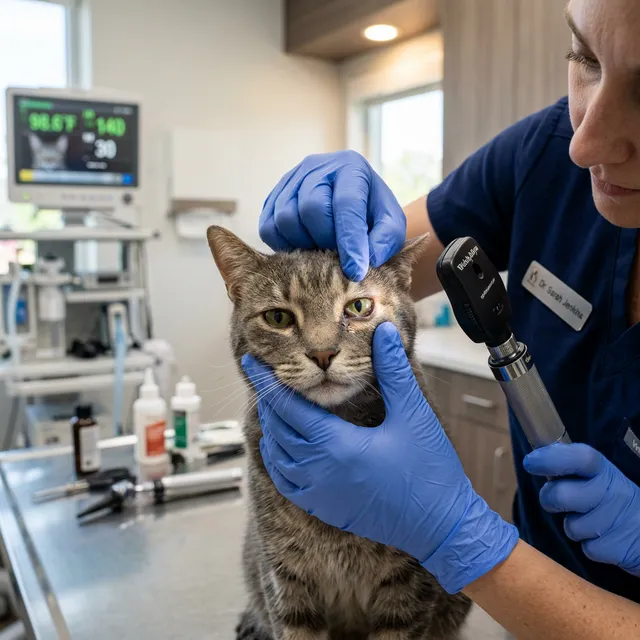
Checking for corneal ulcers is a
critical part of a respiratory exam.
4. The “Chronic Sniffler”:
Long-Term Consequences
Some cats never fully recover. If the initial infection was severe, it can cause
permanent damage to the delicate nasal turbinates (the tiny bones inside the nose). This leads
to Chronic Rhinosinusitis. These cats may sneeze and have nasal discharge for
the rest of their lives. Management involves periodic humidification and occasional antibiotic
pulses during flare-ups.
5. Vaccination: Protection
Not Prevention
The FVRCP vaccine is the “core” protection. It is important to realize that the
vaccine may not prevent your cat from *getting* the virus, but it vastly reduces the *severity*
of the illness. A vaccinated cat may experience a mild “sniffle” where an unvaccinated one would
face critical hospitalization.
Conclusion: Vigilance is the
Best Medicine
Feline Upper Respiratory Disease is a marathon, not a sprint. It requires a
dedicated owner who can monitor small changes in breathing, appetite, and energy. By
understanding that “cat flu” is a multi-pathogen threat, you can work more effectively with your
veterinarian to provide the supportive care your companion needs to survive and thrive. Never
assume it’s “just a cold”—their life may depend on your proactiveness.
— Last update —