
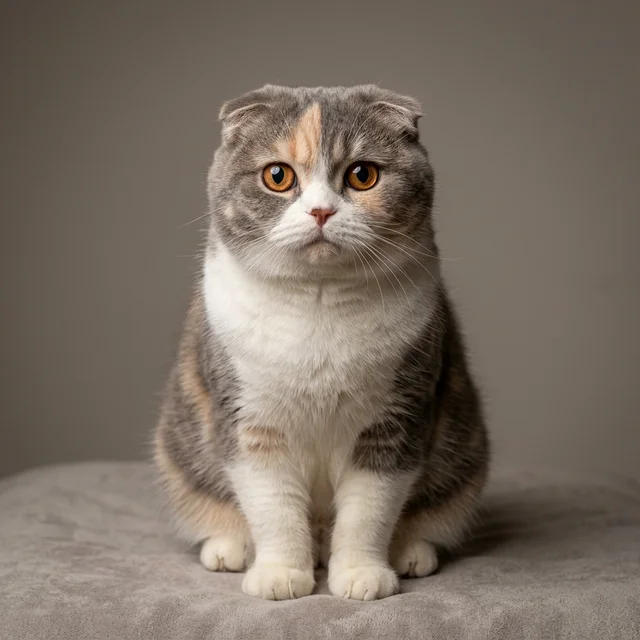
Breed
Profile
With their round
faces, large eyes, and unique folded ears, Scottish Folds look remarkably like owls or
teddy bears. But beyond their adorable looks, they are sweet-tempered, easygoing
companions who love nothing more than being with their humans.
⚡ Quick Look
Scottish Folds are famous for the “Buddha
Sit”—sitting up on their hind legs with their paws on their belly. They are quiet,
soft-voiced, and adapt perfectly to any home environment, from noisy families to
quiet singles.
Origin: Susie’s
Legacy
Every Scottish Fold alive today can trace its ancestry back to a single barn
cat named Susie. Found in Tayside, Scotland, in 1961, Susie had unique
ears that folded forward due to a natural genetic mutation. A neighbor and cat
enthusiast, William Ross, adopted one of her kittens, Snooks, and began the breeding
program.
Interestingly, the breed was not initially accepted by the UK registry due
to concerns about ear health (which proved largely unfounded with good breeding).
Instead, the breed flourished in the United States, where it was refined into the round,
sturdy cat we know today.
Personality: Sweet
and Silent
If you want a cat that is present but not demanding, the Scottish Fold is
ideal. They are not as active as Bengals nor as vocal as Siamese. They are content to
simply be.
🧘 The Buddha Position
You will often find them sitting in hilarious
human-like poses. They also like to sleep flat on their backs!
🤫 The Quiet Observer
They rarely use their voice, but when they do,
it’s a tiny, soft chirp. They prefer to communicate with their large, expressive
eyes.
Appearance: Round,
Round, Round
The breed standard calls for a “round” look: round head, round eyes, round
body, and round feet.
- Ears: Kittens are born with straight ears. At about 3-4 weeks, the
ears may fold. Folds are graded as single, double, or triple (the show
quality “cap-like” fold). - Coat: Comes in both Shorthair (dense and plush) and Longhair
(Highland Fold) varieties.
Health & Ethics
It is crucial to know that the gene causing the folded ears (Fd) also
affects cartilage elsewhere in the body. This condition is called
Osteochondrodysplasia. Responsible breeders NEVER breed two folded-ear
cats together (Fold x Fold is forbidden). They always outcross with British or American
Shorthairs (Straight x Fold) to ensure the kittens are healthy.
Care: Clean their ears regularly! The tight fold can trap
wax and lead to infection if ignored. Handle their tail gently, checking for stiffness
which can be a sign of arthritis.
Fall in Love with the Fold?
Their sweet expression and gentle nature make them one
of the most beloved breeds in the world.
— Last update —
I live with one of these cats she wake me up every morning by gently touch my face. I dont need alarm clock they are all very funny and lovely cats
I want a Scottish fold I’m from cyprus I don’t know if is any breeder here I don’t know where to find one pls help