
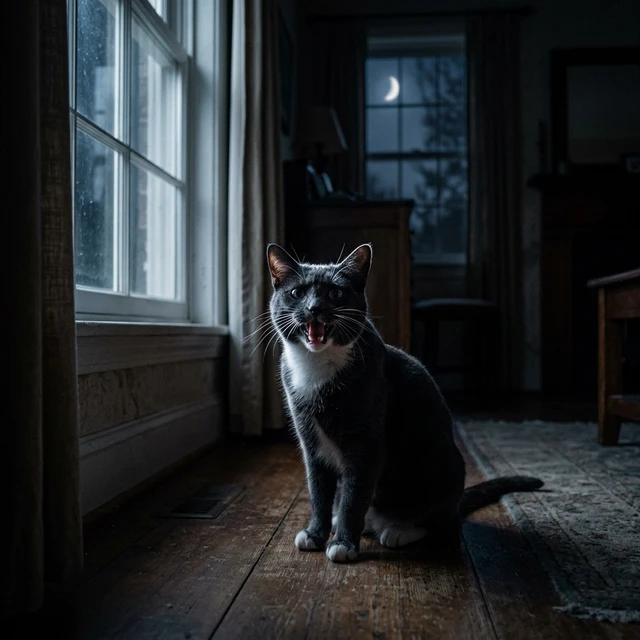
The Midnight
Serenades: Understanding Feline Nocturnality
🔑 Key Takeaway: The
Crepuscular Peak
Cats are not strictly nocturnal; they are **crepuscular**,
meaning their biological peak of activity occurs at dawn and dusk. When your cat meows
at 3 AM, they are experiencing a surge of metabolic energy designed for hunting.
Managing this behavior requires aligning their “circadian hunter” routine with your
sleep schedule through physical and mental enrichment.
Persistent nighttime vocalization is one of the most common challenges for cat
owners. While it is often dismissed as “attention-seeking,” excessive meowing—especially in
senior cats—is frequently a symptom of deep-seated biological, medical, or cognitive
triggers. This guide provides a clinical and behavioral framework for identifying the root
cause and implementing a “Quiet Nights” protocol.
1. Medical Triggers:
Beyond the Behavior
Before attempting behavioral modification, it is critical to rule out
physiological causes. Several conditions can dramatically increase vocalization levels
during the night:
- Hyperthyroidism: An overactive thyroid gland speeds up the metabolism,
causing restlessness, hunger, and a “manic” energy that often manifests as loud,
persistent meowing. - Systemic Hypertension: High blood pressure, common in cats with kidney
disease, can cause a sense of anxiety and physical discomfort that leads to vocalizing. - Cognitive Dysfunction Syndrome (CDS): Often referred to as “feline
dementia,” CDS causes disorientation in senior cats. At night, when the house is dark
and quiet, these cats may feel lost and meow for reassurance.
2. The “Hunt, Kill,
Eat, Sleep” Protocol
To stop nighttime meowing, you must work *with* the cat’s biology. The most
effective method is to simulate a complete predatory cycle immediately before bed. Use
high-intensity play (the hunt/kill) followed by a protein-rich meal (the eat). This triggers
the post-prandial relaxation phase (the sleep), ensuring the cat’s energy is depleted when
you turn out the lights.
| Cause | The “Why” | The Solution |
|---|---|---|
| Boredom/Under-stimulation | Stored predatory energy. | 30-minute interactive play before 10 PM. |
| Hunger (Early Bird) |
Pre-dawn hunting drive. | Timed automatic feeder set for 4 AM. |
| Senior Disorientation | Loss of sensory landmarks. | Nightlights and pheromone diffusers. |
3. Managing
“Extinction Bursts”
One of the biggest mistakes owners make is responding to the meowing
occasionally. This creates an intermittent reinforcement schedule, which is the hardest
behavior to break. When you decide to ignore the meowing, you will likely experience an
Extinction Burst—a temporary but dramatic *increase* in the intensity and
duration of the meowing as the cat tried the “old” strategy harder. You must remain
consistent during this phase; responding even once will reset the progress.

Consistency and enrichment are the
keys to restoring peace to your household.
Conclusion:
Persistence Pays Off
Stopping nighttime meowing is rarely an overnight success. It requires a tiered
approach: rule out medical issues, satisfy biological drives through play and feeding, and
be resolutely consistent in ignoring attention-seeking cries. By addressing the root cause
rather than just the symptoms, you can help your cat feel secure, satisfied, and silent
throughout the night.
— Last update —