
From Victorian
Curiosities to Global Sport: The Evolution of the Cat Show
🔑 Key Takeaway: The Pillar
of Feline Preservation
Modern cat shows are far more than beauty pageants; they are
sophisticated scientific and cultural events designed to preserve genetic heritage,
promote feline health standards, and educate the public on responsible ownership. Since
the first formal exhibition in 1871, the “Cat Fancy” has evolved into a global network
of dedicated breeders and enthusiasts who use these competitions to ensure the longevity
and health of diverse cat breeds.
The phenomenon of the cat show is a relatively modern invention that reflects
society’s changing relationship with the domestic feline. While cats have shared human homes
for millennia, the formal appreciation of their physical and behavioral traits—known as the
“Cat Fancy”—only began to take shape in the late 19th century. Today, cat shows are
high-stakes competitions held in nearly every country, governed by complex sets of rules and
standards that define the pinnacle of each breed’s potential.
1. The Crystal Palace:
Where It All Began
Before 1871, cats were largely seen through a functional lens—hunters of vermin
and quiet companions of the hearth. This changed on July 13, 1871, when Harrison Weir, an
artist and naturalist with a profound love for felines, organized the first National Cat
Show at the Crystal Palace in London. Weir is often called the “Father of the Cat Fancy”
because he did not just organize the event; he created the first written standards of points
for judging cats.
The exhibition was an overwhelming success, drawing over 170,000 visitors who
were eager to see 170 cats ranging from the common domestic shorthair to exotic Persian
imports. Weir’s vision was revolutionary: he believed that by assigning value to the beauty
and temperament of cats, people would treat them with more kindness and respect. This event
set the template for every modern competition, establishing the idea that a cat’s worth
could be measured through specific physical benchmarks.
2. Modern Governing
Bodies: The Architects of Standards
As the popularity of cat shows spread across the Atlantic and beyond, the need
for formal regulation became apparent. This led to the creation of various governing bodies,
each with its own philosophy and breed standards. Understanding these organizations is
crucial for anyone looking to enter the professional world of feline competition.
- CFA (Cat Fanciers’ Association): Established in 1906 in the United
States, the CFA is one of the world’s most prestigious organizations. It focuses heavily
on purebred preservation and maintains a strict registry of recognized breeds. - TICA (The International Cat Association): Known for being more
progressive, TICA was the first to recognize new breeds like the Bengal and the
Savannah. Their judging style is often praised for its “allbreed” approach, where cats
of different breeds compete in the same final rings. - GCCF (Governing Council of the Cat Fancy): The primary body in the
United Kingdom, maintaining the traditions started by Weir while evolving to meet modern
welfare standards. - FIFe (Fédération Internationale Féline): A major European federation
that manages competitions across dozens of countries, emphasizing international
cooperation in breeding standards.
3. The Judging
Process: More Than Meets the Eye
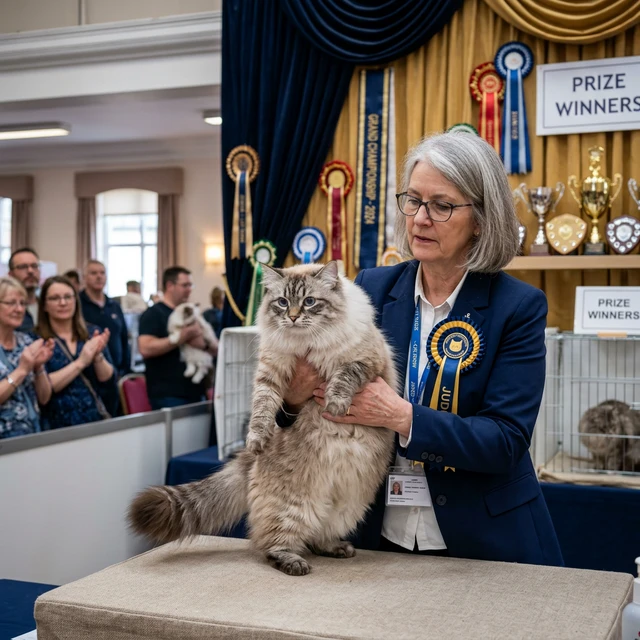
To the casual observer, a judge’s interaction with a cat might look like simple
play. In reality, it is a systematic physical examination. Every recognized breed has a
“Standard of Perfection”—a document that describes the ideal specimen of that breed.
Judges allocate a total of 100 points across various categories, which typically
include:
- Head and Ears (typically 20-30 points): Eye shape, ear set, and the
“profile” or curve of the nose. - Body and Tail (25-35 points): Bone structure, muscle tone, and overall
proportion. - Coat and Color (20-30 points): Texture, length, and adherence to
recognized color patterns (e.g., pointed, tabby, or solid). - Condition and Temperament (10-15 points): Evidence of good health and a
steady, confident personality.
In a professional ring, a judge must handle the cat to feel its underlying
structure. They look for “flow” in the silhouette and “finish” in the coat. A cat that is
beautifully colored but poorly structured will rarely win over a cat with perfect “type”
(adherence to the skeletal standard) but slightly less vibrant markings.
4. Championship vs.
Household Pet Categories
One of the most heartwarming aspects of the modern Cat Fancy is its inclusivity.
While the “Championship” classes are reserved for pedigreed, unaltered purebreds, most shows
feature a thriving “Household Pet” category. In this ring, non-pedigreed cats (the beloved
“moggies”) are judged not on a breed standard, but on their health, grooming, and
exceptional personality.
The Household Pet ring is often the most interactive and fun part of a show,
where judges might reward a cat for its “beautifully expressive eyes” or its “charming,
playful attitude.” This category reinforces the original Victorian goal: celebrating the
feline as a species, regardless of its lineage.
5. Ethical
Considerations and the Future of the Fancy
The future of cat shows is increasingly focused on health and ethics. In recent
years, there has been a significant push away from “extreme” traits that might compromise a
cat’s well-being—such as excessively flat faces in Persians or extreme folds in Scottish
Folds. Modern judging standards are being rewritten to ensure that a winning cat is, first
and foremost, a healthy cat.
disappearing and sets a gold standard for what a healthy, happy cat should look like.”
Conclusion: Why
Support Cat Shows?
Whether you are a breeder or simply a cat lover, visiting a cat show is an
educational experience. It is a place to learn about rare breeds like the Sphynx or the
Selkirk Rex, to speak with experts about nutrition and genetics, and to witness the
incredible bond between humans and their feline companions. By supporting these events, we
support the ongoing research and passion that keep our domestic cats healthy, beautiful, and
deeply integrated into our cultural lives.
— Last update —