
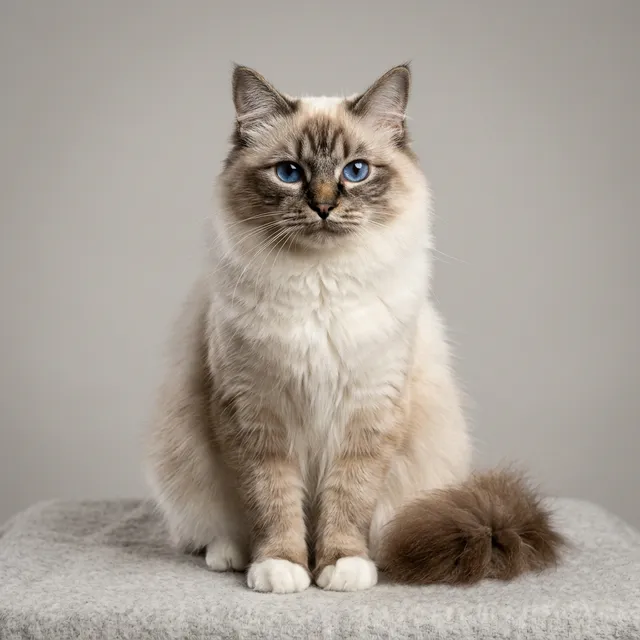
Breed Profile
Shrouded in ancient legend and possessing a breathtaking beauty, the Birman cat is a gentle, affectionate companion known for its striking sapphire blue eyes, silky coat, and pristine white “gloves.” Often called the “Sacred Cat of Burma,” this breed brings a sense of peace and mystique to any home.
The Legend of the Sacred Cat
Few cat breeds have an origin story as romantic as the Birman’s. According to legend, centuries ago in Burma (now Myanmar), pure white cats lived in the Lao-Tsun temple, guarding the golden statue of the goddess Tsun-Kyan-Kse, who had deep blue eyes. The high priest, Mun-Ha, had a beloved cat named Sinh. One night, raiders attacked the temple and killed Mun-Ha as he knelt before the goddess. Sinh immediately jumped onto his master’s body, facing the goddess statue.
In that moment, a miracle occurred. The priest’s soul entered the cat, and Sinh’s white fur turned golden like the goddess’s body. His eyes transformed into the same deep sapphire blue. His face, ears, and tail took on the color of the fertile earth (brown), but his paws, resting on his pure master, remained snowy white. The other temple cats underwent the same transformation. It is said that when a temple cat dies, it escorts the soul of a priest to the afterlife.
History and Origins
Historically, the Birman likely arrived in Europe (specifically France) around 1919. A pair of Birmans was reportedly sent to Major Gordon Russell and August Pavie as a gift from temple priests for their help. The male died during the voyage, but the female, Sita, was pregnant and established the breed in the West. The breed faced extinction during World War II, with reportedly only two Birmans left alive in Europe at one point, but dedicated breeders revived the population by crossing them with long-haired breeds like Persians and Siamese, eventually re-establishing the pure Birman look.
Physical Appearance
The Birman is a medium-to-large cat with a heavy, stocky body and a sweet, open expression. They are a “colorpoint” breed, meaning they have a light-colored body with darker points on the ears, face, tail, and legs.
The Famous White Gloves
The most distinctive feature of the Birman is its white paws, known as “gloves” on the front feet and “laces” (or gauntlets) on the back legs. The laces on the back legs should extend up the back of the hock in an inverted “V” shape. This trait is a strict requirement for show cats and is incredibly difficult for breeders to perfect.
Coat and Colors
Birmans have a semi-long, single coat. Unlike the Persian, they have no undercoat, which means their fur is silky, lush, and rarely mats. This makes them much easier to groom than other long-haired breeds. Their coat texture is often compared to silk. They come in various point colors, including:
- Seal Point: Deep brown points with a golden-cream body.
- Blue Point: Slate-blue points with a bluish-white body.
- Chocolate Point: Milk chocolate points with an ivory body.
- Lilac Point: Pinkish-grey points with a white body.
- Red, Cream, and Tortie Points: Added in later breeding programs.
Personality and Temperament
The Birman is the diplomat of the cat world. They are famously calm, patient, and tolerant. They are not as vocal or demanding as the Siamese, nor as placid as the Persian—they strike a perfect balance.
Affectionate and Social
Birmans are “people cats” who love to be where the action is. They will follow you from room to room and “help” with chores (like making the bed or typing on your keyboard). They are generally not lap cats that stay put for hours, but they prefer to sit right next to you or rest a paw on your arm to maintain contact. They are excellent with children and other pets due to their patient nature.
Quiet Companions
While they will greet you with a soft, chirping voice, they are not loud. They communicate more with their expressive eyes and body language. They are intelligent and curious, often figuring out how to open doors or retrieve toys, but they are rarely destructive.
Care and Maintenance
Because the Birman lacks a troublesome undercoat, grooming is a breeze compared to other longhairs. A good combing once or twice a week with a steel comb is usually sufficient to keep their coat silky and remove loose hair. They shed more during the spring and autumn coat changes.
Like all cats, they need regular dental care (brushing is best), nail trimming, and ear cleaning. Birmans can be prone to weight gain because they are not overly active, so monitoring their diet and encouraging play is important to keep them in shape.
Health and Longevity
Birmans are generally a healthy and long-lived breed, often reaching 15 years or more. However, some genetic lines may be predisposed to:
- Hypertrophic Cardiomyopathy (HCM): The most common heart disease in cats.
- Kidney Disease: Regular vet check-ups can catch this early.
- Hypotrichosis: A rare condition where kittens are born without hair, though this is uncommon in well-bred lines.
Is a Birman Right for You?
If you are looking for a cat that is beautiful but low-maintenance in the grooming department, affectionate but not clingy, and playful but not hyperactive, the Birman is an excellent choice. Their legendary past adds a touch of magic to a breed that is already enchanting in every way. Whether you believe the legend or not, having a Birman look at you with those soulful blue eyes feels truly sacred.
Tags
— Last update —
Burma’s Sacred Cat is also popularly known as the Birman Cat. It has long, silky fur. However, what I love most about it is its round, deep blue eyes. I also like its nose which is distinctly Roman. It does not shed a lot as it does not have an undercoat. This means less time for cleaning and more time for cuddling. It looks like it wears a glove because of the symmetric white paws. The Birman cat is born white but its color changes after about a week. It comes in colors seal, blue, red, chocolate, lilac, and cream.
wonderful cat, My Aegean gave birth to a nicely featured Birman, It could be mistaken for a simese. How would I really know? It does look like it has Manx in it, but it did have 3 nice specimens of Aegean offspring. Good fortune to the greeks who have solved their vermin problem. This is what happens when I let my Aegean go wild and hook up with a Birman or equivilant.