
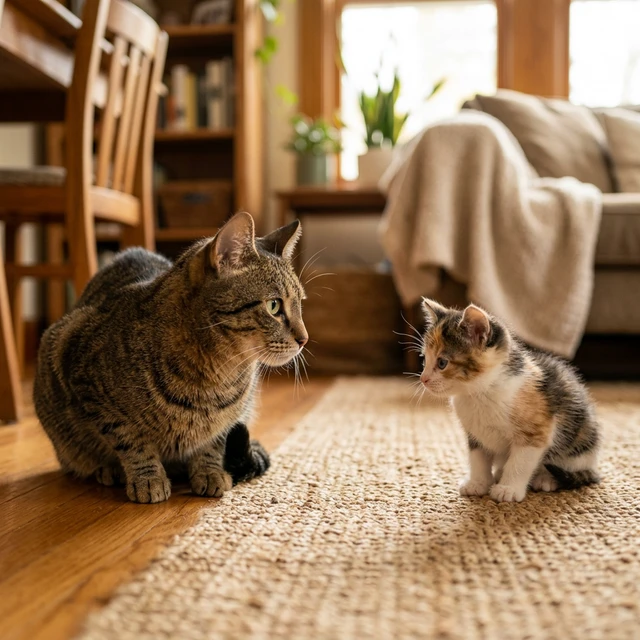
The Neurobiology of
the Kitten Socialization Window
🔑 Key Takeaway: The “Safe
Room” Base Camp
A new home is a sensory overload for a kitten. Establishing a
Safe Room Base Camp for the first 7-14 days is non-negotiable. This
prevents ‘sensory flooding,’ which can lead to life-long anxiety. Let the kitten master
one room before facing the whole territory. Integration is built on confidence, not
exposure.
Introducing a new kitten is not merely an event; it is a critical developmental
process. Felines have a unique “socialization window” that peaks between 2 and 7 weeks of
age, but integration into a new home continues well into their first year. Successful
introduction requires a strategic blend of environmental engineering and positive
reinforcement conditioning.
1. The Safe Room
Architecture
Your kitten’s “base camp” should be a small, quiet room with minimal traffic.
This room acts as a neurological reset point. It must contain the “Essential Five” resources
in a specific spatial arrangement to prevent territorial confusion.
- Spatial Separation: Never place food and water bowls next to the litter
box. In nature, cats would never eliminate where they eat; doing so in a small room can
cause immediate stress and litter box aversion. - Vertical and Low Hiding Options: Provide a cat cave for low-level
hiding and a secure shelf or stool for high-level observation. Safety is perceived
through elevation.
2. The Science of
Scent-Swapping and Pheromones
Before visual contact occurs—especially if you have existing pets—you must
engage in Olfactory Introduction. Cats live in a world of chemical signals.
Use synthetic pheromone diffusers (like Feliway) to create a background layer of “safety
signals” throughout the home.
| Stage | Technique | Neurological Goal |
|---|---|---|
| Olfactory | Scent swapping with blankets. | Normalizing the new entity’s signature without a physical threat. |
| Auditory | Feeding on opposite sides of a door. |
Associating the sound/smell of the other with a positive dopamine reward (food). |
| Visual | Controlled gate sightings. | Confirming presence while maintaining physical safety boundaries. |
3. Positive
Reinforcement Conditioning (PRC)
Kittens are highly plastic in their learning. Use Clicker
Training or verbal markers to reward confident behaviors. If the kitten
approaches you or a new object, reward them with a high-value treat. This “builds up” their
bravery and reduces the likelihood of “hider” behavior in adulthood.
4. The First
Veterinary Baseline
A “well-kitten” check within the first 72 hours is essential. This isn’t just
for vaccines; it’s to screen for Upper Respiratory Infections (URI) or parasites common in
shelter/breeder environments that can flare up during the stress of a move.

Confidence is built in layers. Give
your kitten the time to master their safe space first.
Conclusion: Beyond the
First Day
The success of a kitten’s introduction is measured by their willingness to
display vulnerable behaviors (like grooming or sleeping in the open) outside of their safe
room. By respecting the biological need for a gradual, scent-based introduction and
providing high-value dental and vertical rewards, you ensure your kitten grows into a
well-adjusted, confident adult cat.
— Last update —