
Thinking Like a Predator:
The Philosophy of Feline Home Safety
🔑 Key Takeaway: The “Curiosity
Gap”
Feline curiosity is a survival mechanism, but in a human home, it can
be a liability. Cat-proofing is not about restriction—it is about “hazard mitigation.” By
viewing your home three dimensionally (the “vertical world”), you can identify risks that
are invisible to ground-dwellers. Safety is a dynamic process, not a one-time
event.
The domestic home is filled with “silent killers”—substances and structures that are
harmless to humans but lethal to the unique metabolism and anatomy of a cat. This guide provides
a clinical, room-by-room breakdown of how to prepare your environment for a feline resident,
focusing on the four critical pillars of home safety.
1. Chemical and Metabolic
Warfare: The Hidden Toxins
Cats lack certain liver enzymes (glucuronyltransferase) required to break down
phenols and other common chemicals. This makes them significantly more vulnerable to poisoning
than dogs or humans.
The Essential Oil Myth
Diffusing oils like tea tree, peppermint, or citrus can
cause respiratory distress and liver failure through dermal absorption or inhalation.
Action: Avoid diffusers in rooms where cats reside.
Antifreeze (Ethylene Glycol)
A single teaspoon is fatal. It has a sweet taste that
cats find irresistible. Action: Switch to propylene-glycol based
antifreeze or store containers in sealed bins.
2. Physical Hazards: The
Anatomy of “High-Rise Syndrome”
“High-rise syndrome” refers to the specific injuries sustained by cats falling from
heights of two stories or more. While cats have an “extensor thrust reflex” that helps them land
on their feet, the impact often causes shattered jaws, broken ribs, and pneumothorax (collapsed
lungs).
- Window Integrity: Standard insect screens are designed to keep bugs out,
not to hold a 10lb cat lunging at a fly. Replace standard mesh with **PetScreen
(vinyl-coated polyester)**. Always use window locks to prevent sliding windows from
vibrating open. - The Balcony “Catio”: If you have a balcony, it must be fully enclosed with
specialized cat netting or transparent mesh. Never assume a cat’s “natural balance” will
prevent a fall during a moment of high-prey-drive distraction. - Vertical Structural Safety: Heavy furniture (bookshelves, dressers) should
be anchored to the wall using “anti-tip” straps. A jumping cat can easily destabilize a
top-heavy unit.
3. Electrical Safety:
Preventing the “Chomping” Burn
For a bored cat or a teething kitten, an electrical cord is a perfect “chew toy.”
This often leads to “electrical edema” (fluid in the lungs) and severe oral burns.
| Risk Level | Hazard | Mitigation Strategy |
|---|---|---|
| Critical | Exposed lamp and PC cords | Use **split-loom tubing** or rigid PVC cord concealers. |
| High | Dangling blinds strings | Replace with cordless blinds or use cord cleats to wind them high up. |
| Moderate | Countertop appliances | Unplug when not in use. Prevent jumping with “ScatMats” or aluminum foil. |
4. Ingestion Security: The
“Linear Foreign Body” Problem
The most common reason for emergency abdominal surgery in cats is the ingestion of
household items. Cats have backward-facing barbs (papillae) on their tongues; once they start
swallowing a string, they literally cannot spit it out.
Common Household Culprits:
- Kitchen Waste: Chicken bones (splintering), dental floss, and meat
trimmings. Use lidded trash cans with locking mechanisms. - Holiday Decor: Christmas tinsel is the leading cause of holiday intestinal
blockages. It is shiny, enticing, and deadly. - Laundry Room: Dryer sheets (toxic chemicals) and small socks. Always keep
the dryer door closed and check for “hitchhiking” cats before starting a load.

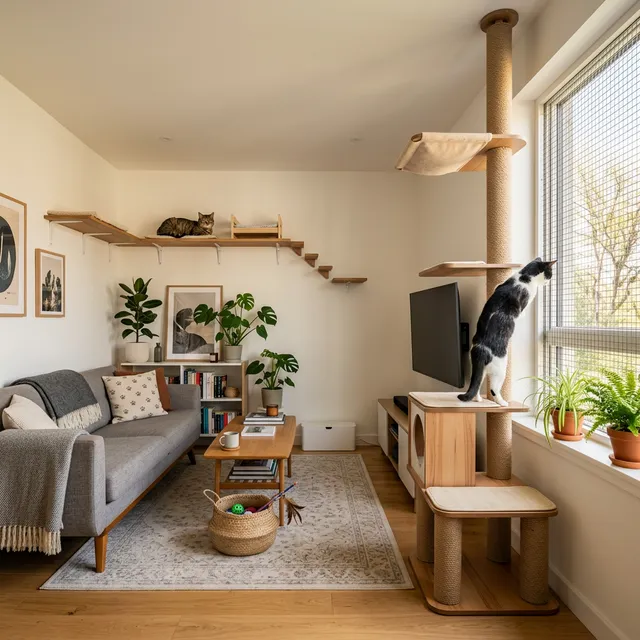
A truly cat-proofed home allows for
vertical exploration without risk.
Conclusion: The Safe
Sanctuary
Cat-proofing is a language of love. By taking these steps, you are telling your cat:
“This environment is yours to explore safely.” It reduces your stress as an owner and provides
the cat with the freedom to express their natural behaviors—climbing, hiding, and
investigating—without the risk of injury. A well-designed home is the foundation of a 20-year
fellowship.
— Last update —