
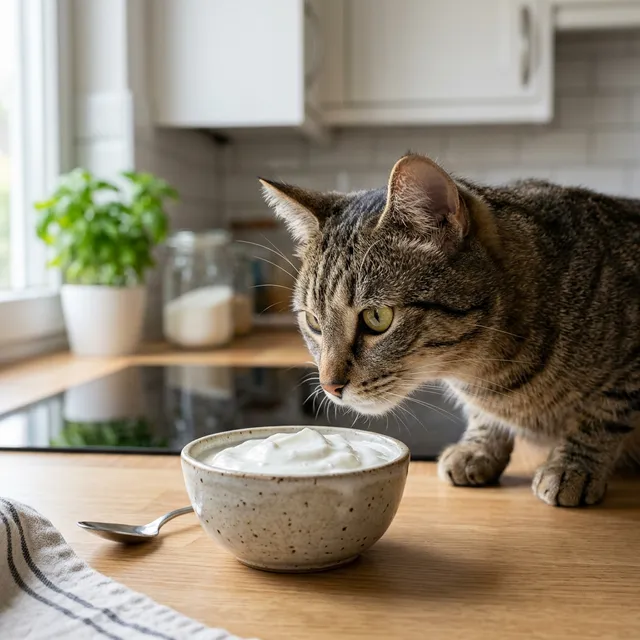
The Feline-Dairy Paradox: Is
Yogurt the Exception to the Rule?
🔑 Key Takeaway: Precision in
Moderation
While adult cats are fundamentally lactose intolerant, plain,
unsweetened yogurt is one of the few dairy products that can be safely enjoyed
as an occasional treat. The secret lies in the fermentation process, where beneficial
bacteria break down most of the lactose that usually causes feline digestive distress.
However, it must be viewed strictly as a “functional treat”—limited to 1-2 teaspoons of
plain Greek or Icelandic varieties—rather than a dietary staple. Never offer flavored or
sugar-free human yogurts, which may contain toxic additives like Xylitol.
The image of a cat happily lapping up a bowl of milk is one of the most enduring
myths in popular culture. Unfortunately, for most adult felines, that bowl of milk is a one-way
ticket to gastrointestinal upset. As obligate carnivores, cats have a highly specialized
digestive system that prioritizes animal tissues. Yet, yogurt often appears on the list of
“safe” human foods for pets. This guide explores the complex science behind why yogurt behaves
differently in the feline gut and how to safely navigate this dairy exception.
1. Feline Physiology: Why
Cats are “Dairy-Challenged”
To understand the safety of yogurt, we must first confront the biological reality of
the adult feline. Evolution has fine-tuned the cat to be the ultimate desert hunter, a creature
whose ancestry lies in the African wildcat (*Felis lybica*).
The Lactase Decline
Like all mammals, kittens are born with the ability to produce **lactase**, the
enzyme required to hydrolyze lactose (milk sugar). This is essential for survival during the
nursing phase. However, as the kitten transitions to solid meat, nature “switches off” the
production of lactase. By the time a cat reaches adulthood, their body is no longer equipped to
dismantle lactose molecules. When an adult cat consumes traditional milk, the undigested lactose
travels to the large intestine, fermenting and causing diarrhea, gas, and discomfort.
The Obligate Carnivore Requirement
Cats lack the metabolic pathways to efficiently process large amounts of
carbohydrates. Dairy products, which are naturally high in sugars (lactose is a disaccharide),
represent a challenge to their blood sugar regulation and digestive efficiency. A cat’s energy
should come primarily from gluconeogenesis—the process of creating glucose from protein—not from
the consumption of dietary sugars.
2. The Fermentation
Loophole: How Yogurt Solves the Lactose Problem
If adult cats are lactose intolerant, why is yogurt often tolerated? The answer lies
in the microscopic workers behind every cup of yogurt: **active bacterial cultures**.
During the production of yogurt, bacteria such as *Lactobacillus bulgaricus* and
*Streptococcus thermophilus* are added to milk. These “good” bacteria consume the lactose as
their energy source, converting it into lactic acid. This process, known as fermentation,
effectively “pre-digests” the dairy, reducing the lactose content significantly before it ever
enters your cat’s system. This is why a cat who might vomit after drinking milk can often enjoy
a dollop of Greek yogurt without issue.
3. Choosing the “Gold
Standard” Yogurt for Your Cat
Not all store-bought yogurts are safe for feline consumption. In fact, many can be
dangerous. When shopping, follow the “Triple-P” rule: **Plain, Probiotic-rich, and
Protein-focused.**
Greek vs. Regular: The Straining Secret
Greek yogurt is the superior choice for cats because it undergoes multiple straining
processes to remove the liquid whey. This whey contains the majority of the remaining lactose
and sugars. By removing it, the resulting yogurt is thicker, higher in protein, and
significantly lower in lactose than “runny” traditional yogurt.
Icelandic Skyr: The New Feline Favorite
Skyr is technically a soft cheese made using traditional Icelandic methods. It is
naturally even higher in protein and lower in sugar than most Greek yogurts, making it an
excellent alternative for cats who enjoy a thicker, more savory treat.
| Type | Lactose Level | Suitability |
|---|---|---|
| Plain Greek | Lowest | Ideal occasional treat. |
| Plain Skyr | Very Low | Excellent high-protein choice. |
| Standard Plain | Moderate | Use with caution (monitor GI). |
| Fruit/Flavored | High | STRICTLY FORBIDDEN. |
4. The “Dark Side”: Toxic
Additives and Hidden Killers
The biggest threat when feeding yogurt is not the milk protein, but the
human-centric additives. **Reading the label is mandatory.**
The Xylitol Panic (E967)
Xylitol is a sugar alcohol found in many “low-fat” or “sugar-free” yogurts. While
its toxicity in cats is not as aggressively documented as it is in dogs (where it causes fatal
hypoglycemia and liver failure), veterinians treat it as a high-risk toxin. There is no reason
to risk a cat’s life on a sugar substitute that provides zero nutritional value.
Chocolate, Grapes, and Vanilla
Flavored yogurts often contain essential oils, extracts (like vanilla or almond), or
chocolate bits that are toxic to cats. Even “fruit on the bottom” varieties contain high levels
of concentrated sugars and potentially harmful preservatives that can spike a cat’s insulin
levels and lead to obesity or diabetes.
5. Probiotic Potential: Real
Benefit or Marketing?
Many owners give yogurt to “fix” a cat’s diarrhea or improve their coat. While the
live cultures in yogurt are beneficial, it’s important to understand their limitations in the
feline system.
A cat’s stomach acid is significantly more acidic than a human’s (pH of 1-2 compared
to human 2-3). This extreme acidity kills many of the bacteria in yogurt before they can reach
the intestines. While some bacteria do survive, feline-specific probiotic supplements
(containing strains like *Enterococcus faecium*) are far more effective at colonizing the gut
because they are designed for the specific environment of the cat’s colon.
6. The Science of Taste: Why
Do Cats Like It?
Intriguingly, cats cannot taste sweetness. They lack the T1R2/T1R3 receptor protein
required to sense sugars. Yet, many cats go wild for yogurt. This is likely because they are
sensing the **fats and proteins** in the dairy. To a cat, the creamy texture and high fat
content of a premium Greek yogurt are signals of a high-energy food source, appealing to their
instincts as an apex predator.
animal-derived proteins and fats. Our job as owners is to ensure those nutrients don’t come at
the cost of digestive distress.”
7. How to Safely Introduce
Yogurt: The “Matchbox” Rule
If you want to try yogurt as a treat, follow these steps to ensure a safe
transition:
- Start Microscopic: Offer a tiny amount—no bigger than a pea—on your
fingertip. Wait 24 hours to check for loose stools or vomiting. - The 1 teaspoon Limit: If tolerated, you can increase the amount to a
teaspoon. For an average 10lb cat, one teaspoon is plenty. - Frequency Matters: Yogurt should be an “event,” not a daily routine. Limit
it to twice a week to avoid upsetting the balance of their primary meat-based diet. - Temperature Control: Cats often prefer food at room temperature. Cold
yogurt straight from the fridge can be jarring to their sensitive stomachs.
Conclusion: A Savory, Safe,
and Selective Treat
In the world of cat nutrition, yogurt is a rare bridge between human “comfort food”
and feline safety. When handled with precision—using only plain, high-protein, low-lactose
varieties—it serves as a rewarding treat that can even provide subtle health benefits. By
respecting your cat’s biological boundaries and remaining vigilant against toxic additives, you
can share a small moment of culinary joy with your feline friend while keeping their health and
happiness first.
— Last update —