Breed Profile
The Thai cat, often referred to as the “Old-Style Siamese,” is a breed that captures the essence of traditional elegance and modern affection. With its striking blue eyes, distinctive point coloration, and a personality that is both vocal and loving, the Thai cat is a living bridge to the feline history of Thailand (formerly Siam). Unlike the ultra-modern, angular Show Siamese, the Thai retains the moderate, rounded features of its ancestors, making it a robust and relatable companion for cat lovers worldwide.
History and Origins: A Royal Legacy
The history of the Thai cat is deeply intertwined with the history of the Siamese breed. For centuries, these cats existed in Thailand, depicted in the “Tamra Maew” (The Cat-Book Poems), a manuscript dating back to the Ayutthaya Kingdom (1351–1767). These ancient texts described cats with pale coats and dark points, revered in temples and royal courts.
When the first Siamese cats arrived in the West in the late 19th and early 20th centuries, they looked very much like today’s Thai cats. They had moderate bodies, apple-shaped heads, and a substantial build. However, as decades passed, Western breeders began to favor a more extreme look—longer bodies, wedge-shaped heads, and larger ears. This divergence created the modern Siamese breed we see in show rings today.
Fortunately, a dedicated group of breeders and enthusiasts sought to preserve the original look of the “wichienmaat” (moon diamond) cats. In the 1990s and early 2000s, this effort gained formal recognition. The International Cat Association (TICA) granted the Thai cat championship status in 2010, officially recognizing it as a distinct breed that preserves the phenotype of the native pointed cats of Thailand. Today, the Thai cat stands proudly not as a “lesser” Siamese, but as the authentic representation of the breed’s historical roots.
Appearance: The Classic Beauty
The Thai cat is a study in balance. It is a medium-to-large cat, possessing a body that is elegant yet muscular, neither tubular like the modern Siamese nor cobby like the British Shorthair.
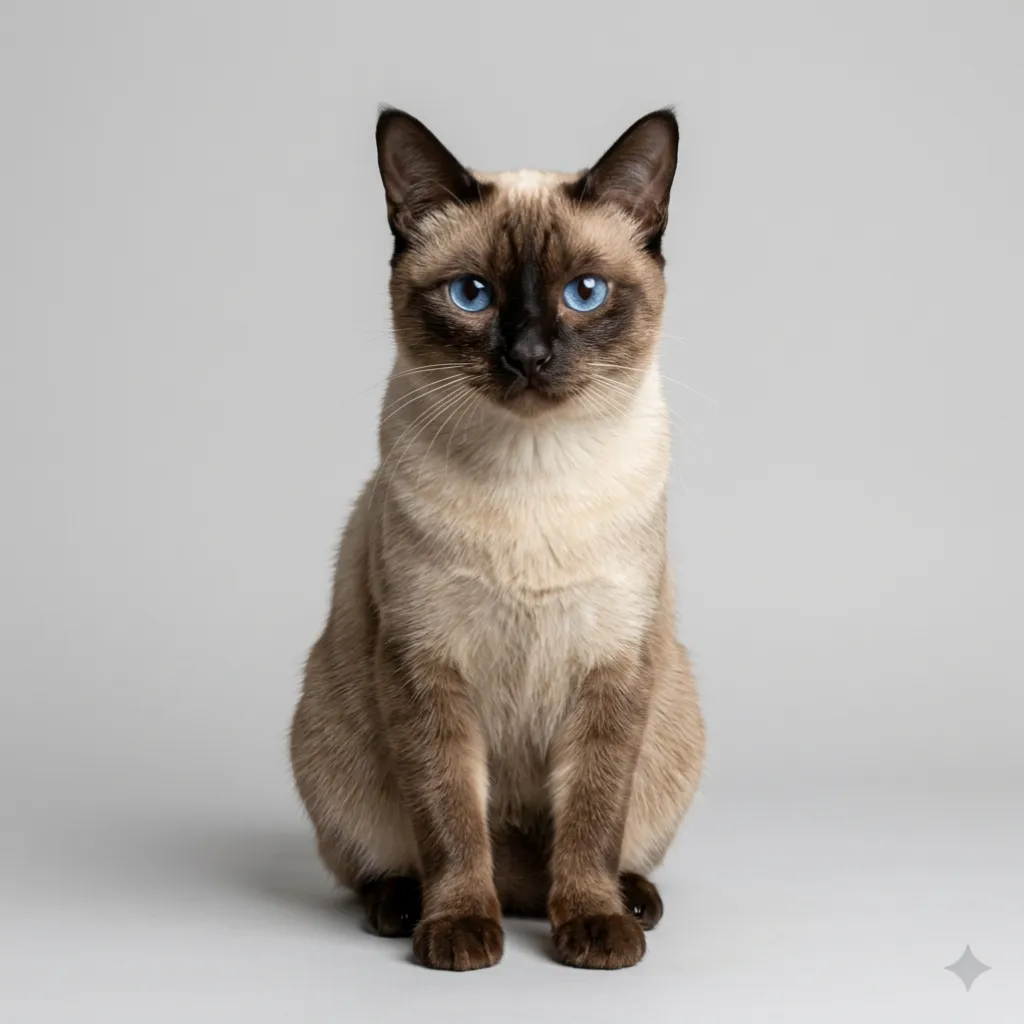
- Head Shape: The hallmark of the breed is its “apple head”—a modified wedge with rounded contours. The forehead is flat and long, and the muzzle is medium in length, neither pointed nor blunt.
- Eyes: Their eyes are a captivating feature—large, almond-shaped on top and rounded at the bottom, set in a way that gives them an alert and intelligent expression. The color is always a vivid, intense blue, ranging from sky blue to deep sapphire.
- Ears: Medium in size, wide at the base, and with rounded tips. They are set as much on the top of the head as on the side, contributing to the cat’s alert appearance.
- Body: The torso is moderately long and substantial, supported by medium-length legs and oval paws. The tail is tapered and of medium length, often matching the body’s grace.
- Coat and Color: The coat is short, fine, and silky, lying close to the body with little undercoat. The Thai cat is a pointed breed, meaning it has a pale body color with darker “points” on the ears, face, tail, and legs. Common colors include Seal, Chocolate, Blue, and Lilac, though TICA accepts all point colors, including Tabby (Lynx) and Tortie points.
Personality: The “People’s Cat”
If you are looking for an aloof decoration for your sofa, the Thai cat is not for you. These cats are renowned for their intense people-oriented nature. They are often described as “dog-like” because they will follow their owners from room to room, supervising every activity from cooking to showering.
Vocal and Communicative: Like their Siamese cousins, Thai cats are talkers. They will greet you at the door, tell you about their day, and demand attention if they feel ignored. Their voice is distinct and expressive, capable of a wide range of chirps, meows, and trills. They are not shy about communicating their needs, whether it’s an empty food bowl or a desire for a lap to sit on.
Intelligent and Active: Thai cats are highly intelligent problem solvers. They can learn to open doors, fetch toys, and even walk on a leash. They require mental stimulation to stay happy. Puzzle toys, interactive play sessions, and climbing trees are essential for this breed. A bored Thai cat can become mischievous, finding creative ways to entertain themselves, often at the expense of your household order.
Affectionate Companions: Above all, they are lovers. They thrive on physical contact and will often sleep under the covers with you or curl up on your shoulder while you work. They are generally good with children and other pets, provided they are introduced properly. Their high energy levels make them excellent playmates for active kids.
Living Needs and Care
Caring for a Thai cat is relatively straightforward, but they do have specific needs to ensure they thrive.
Environment
These active cats need vertical space. Cat trees, shelves, and window perches are highly recommended. They love warmth and will often be found sunbathing or seeking out the warmest lap in the room. Because of their high social needs, they do not do well in isolation. If you work long hours, it is strongly advised to get a pair of cats so they can keep each other company.
Grooming
The short, single coat of the Thai cat is low-maintenance. A weekly brushing with a rubber mitt or soft bristle brush is usually sufficient to remove loose hair and keep the coat shiny. They are generally clean cats and groom themselves fastidiously. Regular nail trimming and ear cleaning should be part of their routine, along with dental care to prevent periodontal disease.
Diet and Nutrition
Thai cats are active and muscular, requiring a high-quality diet rich in animal protein. Wet food is often preferred to help maintain hydration and support kidney health. Be mindful of portion control, as some Thai cats can be prone to obesity if overfed, especially after neutering. Always provide fresh water, perhaps via a cat fountain, as many cats prefer running water.
Health and Longevity
The Thai cat is generally a healthy and robust breed, often living into their late teens or even early twenties. Their diverse genetic background, partly due to the recent outcrossing with native cats from Thailand, contributes to their vigor.
However, like all breeds, they can be predisposed to certain conditions. Because they share ancestry with the Siamese, they may occasionally be prone to:
- Dental Issues: Gingivitis and periodontal disease can occur, making dental hygiene important.
- Amyloidosis: A rare condition where protein deposits affect organs, primarily the liver. Reputable breeders screen for this.
- Progressive Retinal Atrophy (PRA): A genetic eye condition that can lead to blindness, though genetic testing has largely reduced its prevalence in breeding lines.
Regular veterinary check-ups, vaccinations, and parasite control are essential for a long and healthy life.
Is a Thai Cat Right for You?
Bringing a Thai cat into your home means welcoming a highly interactive family member. They are not passive observers; they are participants in your life. If you want a quiet, independent cat that sleeps all day, the Thai might be overwhelming. But if you desire a devoted, intelligent, and conversationally gifted friend who will greet you with joy every day, the Thai cat is an incomparable choice.
Their combination of historical mystique, robust health, and engaging personality makes the Thai cat a jewel of the feline world—a true “Diamond of the Moon” that shines brightly in the hearts of those who love them.
— Last update —