Allogrooming: The
Social Architecture of Feline Cleaning
🔑 Key Takeaway: The
“Colony Scent” Strategy
When cats clean each other (allogrooming), they are doing more
than hygiene; they are creating a unified Colony Scent. By mixing their
individual pheromones through saliva exchange, they identify ‘friend’ from ‘foe.’ In a
domestic household, allogrooming is the ultimate signal of social acceptance and
conflict resolution.
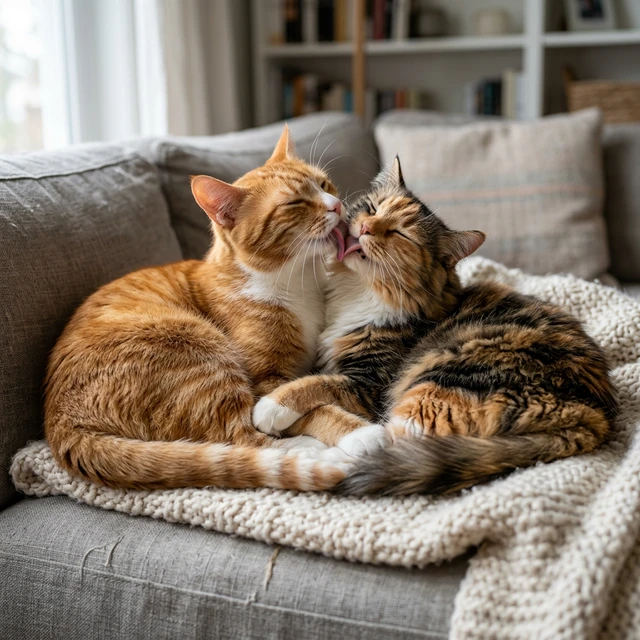
The act of mutual grooming, scientifically known as allogrooming, is a
foundational social behavior in the Felidae family. While cats are fastidious self-groomers,
allogrooming is a targeted social interaction reserved for ‘preferred associates’—cats with
whom they share a deep, stable bond. This guide explores the evolutionary, social, and
physiological nuances of why cats groom one another.
1. Hierarchy and
Social Dominance Through Grooming
Counterintuitively, allogrooming is often used as a tool for establishing and
maintaining social hierarchy. In many feline colonies, the Affiliative
Dominant cat is the one who performs the most grooming, specifically focusing
on the head and neck regions of other cats.
- The Groomer vs. The Groomee: The cat doing the grooming is often taking
a parental or protective role. Grooming the head—an area the other cat cannot reach
itself—is an act of both service and social asserting. - Grooming-Induced Submission: The cat receiving the grooming often adopt
a submissive posture (closing eyes, tilting the head), which reinforces the peaceful
social order of the group.
2. The Physics of
Salivary Cooling and Hygiene
Beyond social bonding, allogrooming has practical physiological benefits. A
cat’s saliva contains enzymes that help break down surface oils and regulate skin health.
Furthermore, as the saliva evaporates, it provides Evaporative Cooling,
helping the colony manage their body temperatures during rest periods.
| Grooming Zone | Social Meaning | Practical Benefit |
|---|---|---|
| The Crown & Ears | Parental bonding/Dominance. | Cleaning areas the cat cannot reach with their own paws. |
| The Neck & Chin | Vulnerability and Trust. | Stimulating scent glands for pheromone distribution. |
| The Tail Base | Social play/Mating signals. | Hygiene in a high-intensity area. |
3. Conflict Resolution
and De-escalation
In a multi-cat household, allogrooming often follows a period of tension or
play-fighting. It acts as a Behavioral Reset. If two cats have had a minor
disagreement, one may begin grooming the other as a way to say, “The conflict is over; we
are still a pride.”
4. From Grooming to
“Love Bites”: Understanding Overstimulation
It is common for an allogrooming session to end abruptly with a bite or a swat.
This is typically not aggression, but Sensory Overstimulation. The
repetitive motion of the sandpaper-like tongue (papillae) can cause a build-up of static
electricity or nerve sensitivity. When it becomes too much, the cat provides a “Love Bite”
to signal that the session has concluded.

Mutual grooming is a vital social
glue that keeps feline colonies harmonized and secure.
Conclusion: The
Language of the Tongue
Allogrooming is a testament to the complex social lives of cats. By
understanding that grooming is a mix of hygiene, hierarchy, and health, owners can better
interpret the relationships between their pets. When you see your cats cleaning each other,
you are witnessing the successful maintenance of an invisible, scent-based social contract
that ensures the stability of their domestic territory.
— Last update —