
The Physics of Feline
Action: Shutter Speeds and Frame Rates
🔑 Key Takeaway: The
“Frozen Moment”
Cats move with explosive speed that defies human reaction
time. To capture a sharp image of a cat mid-jump or mid-play, you need a minimum shutter
speed of 1/1000th of a second. Relying on “Auto” mode will almost
always result in motion blur. Photography is the art of freezing
micro-expressions that are otherwise invisible to the naked eye.
Feline photography is a discipline that requires the technical precision of
sports photography and the delicate lighting of high-fashion portraiture. A cat’s coat, with
its billions of individual hairs, represents one of the most complex textures for a digital
sensor to resolve accurately. This guide provides a masterclass in the technical and
psychological strategies required to capture award-winning images of your feline companion.
1. Advanced Optics:
The “Bokeh” of the Feline Form
To make a cat truly stand out from a household environment, you need to
understand depth of field. A narrow depth of field (low f-number) creates a professional
“separation” that draws all focus to the subject.
- The Aperture sweet spot: While f/1.8 provides the most blur, it can
make it difficult to keep both an ear and an eye in focus. For close-up portraits,
f/2.8 to f/4 is often the ideal compromise, providing a creamy
background while maintaining structural detail in the cat’s face. - Focal Length and Distortion: Avoid wide-angle lenses (like the standard
1x lens on most phones) for close-ups. They distort the cat’s proportions, making the
nose look unnaturally large. Use a 50mm or 85mm equivalent lens to
compress features and create a flattering, naturalistic perspective. - The Background Compression: By moving further away from the cat and
using a telephoto lens, you “compress” the background, making distractions look like
soft, artistic washes of color.
2. Mastering Eye-AF
and Focus Priority
The most critical technical advancement in modern cameras is Real-time
Animal Eye-AF. These AI-driven algorithms are trained specifically on feline
facial structures.
| Setting | Value | Benefit |
|---|---|---|
| Focus Mode | AF-C (Continuous) | Tracks the cat as they move slightly forward or backward. |
| Shutter Priority |
1/1000s or faster | Eliminates motion blur during high-activity play. |
| Drive Mode |
Burst (10+ fps) | Allows you to pick the exact frame where the eyes are widest. |
3. Texture Retention:
The Post-Processing Masterclass
Digital sensors often try to “smooth out” noise, which can inadvertently turn a
cat’s beautiful fur into a muddy mess. To prevent this, focus on texture persistence in your
editing software.
The “High-Pass” Technique
Instead of using a generic “Sharpen” slider, which creates harsh outlines, use a
High-Pass Filter. This targets only the edges of the hairs, providing a
crisp, lifelike look without increasing grain. Set the radius to 1.5 pixels and use the
“Overlay” blending mode for a subtle but striking increase in fur definition.
4. Lighting without
Stress: The “Reflector” Approach
As discussed, direct flash is harmful and results in low-quality images. The
secret of professional pet photographers is Bounced Lighting. Point your
external flash at a white ceiling or wall behind you. This creates a massive, soft light
source that looks like natural window light and prevents the cat’s pupils from constricting
into narrow slits.

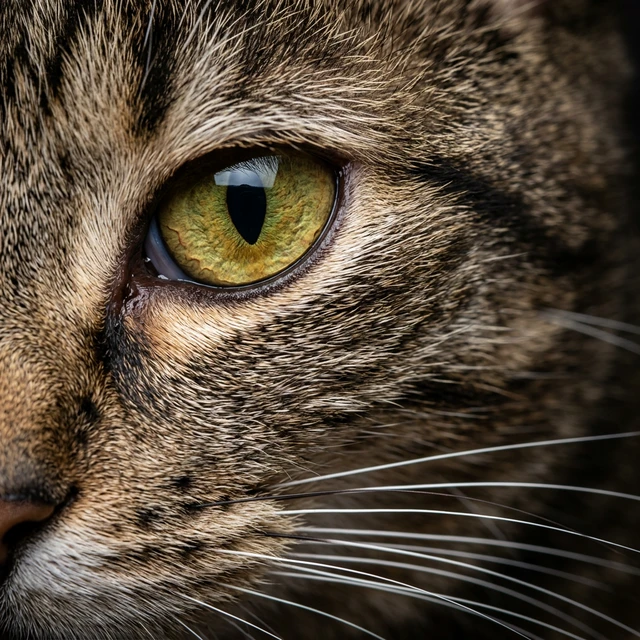
Focusing on the eye closest to the
camera is the golden rule of animal portraiture.
5. Capturing
Personality: The Ethical Photoshoot
A cat’s “soul” is captured in their candid moments, not their posed ones.
Never force a cat into a position. Use “lures” (sound, light, toys) to
guide their gaze. If the cat begins to “whale eye” (showing whites) or flatten their ears,
stop immediately. A stressed cat never takes a good photo.
Conclusion: Beyond the
Snapshot
Feline photography is a journey of technical discovery and biological
appreciation. By understanding the shutter speeds required to freeze action, the optics
needed to separate a subject from clutter, and the post-processing tools required to
maintain texture, you transform your photography from a simple record into a work of art.
These images will serve as a high-fidelity tribute to your cat’s unique life.
— Last update —