Breed Profile
The Toyger cat is a living masterpiece—a domestic cat bred to resemble a miniature tiger, yet possessing the loving, dependable temperament of a house cat. The name “Toyger” is a playful portmanteau of “toy” and “tiger,” perfectly capturing the breed’s essence. With its dramatic striped coat, muscular build, and rolling gait, the Toyger brings the wild allure of the jungle into your living room without any of the danger. Despite its fierce appearance, this breed is known for being intelligent, friendly, and easily trained.
History: Designing a Miniature Tiger
The Toyger is a relatively new breed, the brainchild of Judy Sugden (daughter of Jean Mill, the creator of the Bengal cat). In the late 1980s, Sugden noticed unique markings on her mackerel tabby cat’s temples—circular patterns that were distinct from the standard tabby “M.” This sparked an idea: could a domestic cat be bred to have the true circular face markings of a tiger?
To achieve this vision, Sugden started with a domestic shorthair named “Scrapmetal” and a Bengal cat named “Millwood Rumpled Spotskin.” She later imported a street cat from Kashmir, India, named “Jammie Blu,” who had unique spotting between his ears. Through careful selective breeding, focusing on clarity of contrast and specific pattern placement, the Toyger began to take shape.
TICA (The International Cat Association) accepted the Toyger for Registration Only in 1993, advanced it to New Breed status in 2000, and granted full Championship status in 2007. Today, breeders worldwide continue to refine the breed, working towards an even more tiger-like appearance with features like smaller ears, wider noses, and whiter bellies.
Appearance: The Jungle Look
Every aspect of the Toyger is designed to mimic the tiger’s physique on a smaller scale.
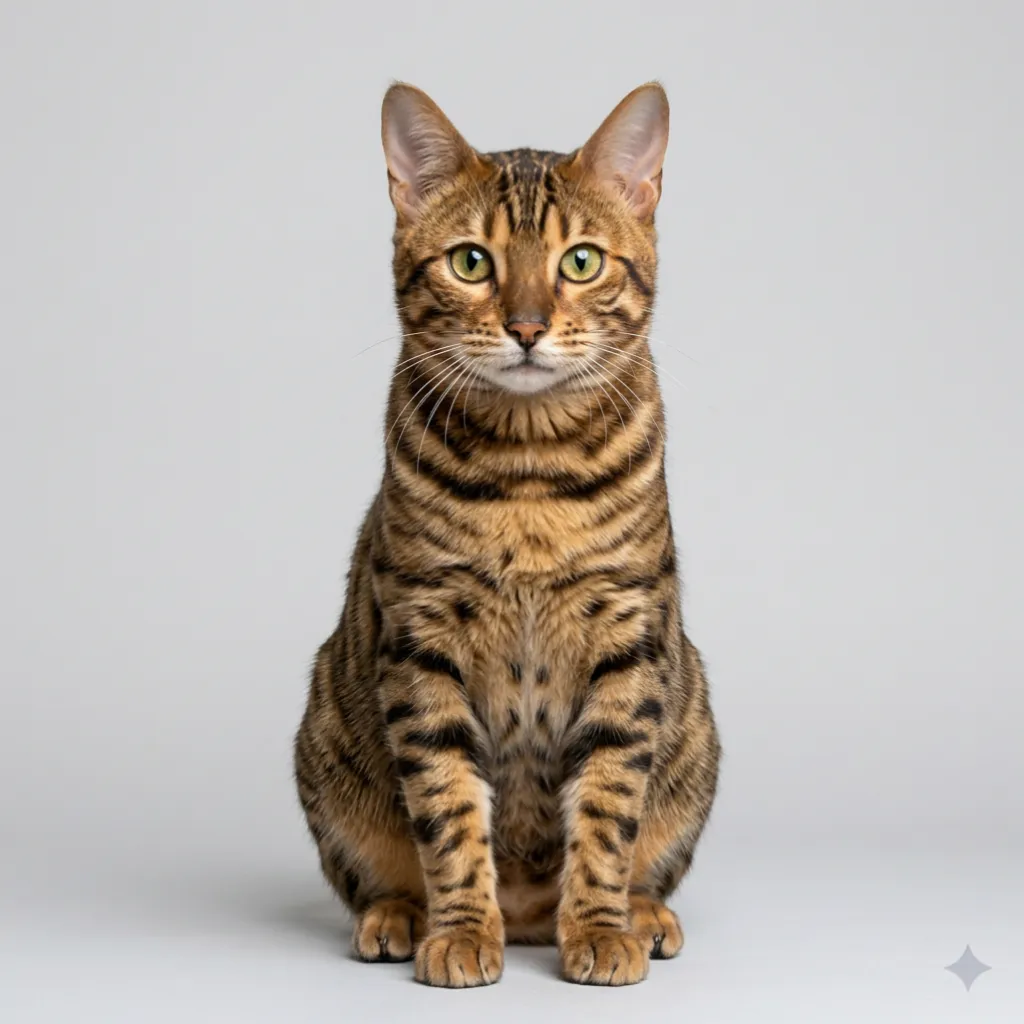
- Coat and Pattern: This is the breed’s defining feature. The coat is short, thick, and plush, with a “glitter” that gives it a rich, soft sheen. The pattern is a “broken mackerel tabby”—vertical stripes that are random, branched, and braided, rather than uniform. The contrast must be extreme: black or dark brown stripes on a vivid orange or gold background.
- Head: The head is medium-sized, oval, and broad, with a long, broad muzzle that resembles the big cat’s powerful jaw. The nose is wide, and the chin is strong.
- Ears: Small and rounded, set wide apart on the head. Unlike most domestic cats whose ears are large and pointed, the Toyger’s ears are designed to look less prominent, mimicking the tiger’s profile.
- Eyes: Small to medium, circular, and set wide apart with a deep, intense color. Dark hooded eyelids contribute to the “wild” gaze.
- Body: The Toyger is muscular and athletic, with a rolling gait that is distinct from other domestic cats. The shoulders are high and robust, giving the impression of a stalking predator.
Personality: A Tiger with a Heart of Gold
Don’t let the wild looks fool you—the Toyger is a pussycat at heart. Bred specifically to be a companion animal, aggressive traits have been rigorously bred out. They are known for their laid-back, confident, and friendly nature.
Intelligent and Trainable: Toygers are highly intelligent. They can be taught to play fetch, walk on a leash, and even perform tricks. They enjoy interactive puzzle toys that challenge their minds. Their intelligence makes them easy to live with, as they quickly learn household rules.
Outgoing and Social: This is not a shy breed. Toygers are typically confident with strangers and get along well with children and other pets. They are “supervisory” cats—they like to be involved in whatever you are doing, whether it’s working at your computer or cooking dinner. They are not overly demanding or vocal, but they will communicate with soft chirps and purrs.
Active but Adaptable: While active and playful, Toygers are not hyperactive like some Bengals can be. They have bursts of energy followed by long periods of relaxation. They adapt well to apartment living as long as they have vertical space (cat trees) and engagement from their owners.
Care and Maintenance
Grooming
The Toyger’s short, plush coat is easy to care for. Weekly brushing is enough to keep it healthy and reduce shedding. They are generally clean cats. Regular nail trimming and ear cleaning are standard requirements. Dental hygiene is important, so brushing their teeth or providing dental treats is recommended.
Diet
Toygers are muscular cats and thrive on a high-protein diet. Quality wet food or a balanced raw diet can help maintain their muscle mass and coat condition. Obesity can be an issue if they are overfed and under-exercised, so monitoring their weight is crucial.
Environment
Create a “jungle” for your Toyger. Tall cat trees, shelves, and scratching posts allow them to climb and survey their territory. They are often fascinated by water and may play in their water bowl or join you in the shower. Providing a fountain can keep them entertained and hydrated.
Health and Longevity
The Toyger is generally a healthy breed with a lifespan of 10 to 15 years. Because the breed is still relatively new and development is ongoing, breeders are very careful about health screening.
- Heart Health: Like many breeds, they can be prone to Hypertrophic Cardiomyopathy (HCM). Responsible breeders scan their breeding cats for this condition.
- Pyruvate Kinase Deficiency (PK Deficiency): A genetic condition affecting red blood cells, which can be tested for.
- General Robustness: Due to the outcrossing with domestic shorthairs during their development, Toygers benefit from a relatively diverse gene pool compared to some older purebreds.
Is a Toyger Right for You?
The Toyger is an excellent choice for someone who loves the exotic look of a wild cat but wants the predictable, safe temperament of a domestic pet. They are conversation starters—guests will always do a double-take when they see a “tiger” walking through your hallway.
However, they are a commitment. They are not cats that can be ignored; they need interaction, play, and love. They are also a rare breed, and kittens can be expensive and hard to find. But for the right owner, the Toyger offers the best of both worlds: the beauty of the wild and the warmth of a loving companion.
— Last update —